

TIPPS FOR AMPLIFIER

[Translate to english:]

What are the important points when selecting a power amplifier?

  • Your T+A loudspeakers can be driven by any amplifier designed to handle a load impedance of 4 Ohms. If the speakers are to be connected to an amplifier rated at 8 Ohms output impedance please check with the amplifier manufacturer that the output stage can handle 4 Ohm speakers without problems.
  • An amplifier and speakers inter-act in a complex manner, and they must be matched accurate-ly if you are aiming at a really top-class sound experience. If you want the best, the simple question "how many Watts does the amplifier supply?" is not enough. We suggest that you check he following points when you are selecting an amplifier.


Output power

There are two aspects to an amplifier's output power: continuous sine-wave power and peak power.

  • When considering output stages you should be sure that the power figures you are comparing refer to the same type of power.
  • You should also check that the manufacturer of the amplifiers states the output power with both channels running simultaneously, since it is only this figure which corresponds to the actual use of the equipment under normal circumstances. T+A loudspeakers are very efficient and therefore do not require an extremely high continuous power output. A value of around 50 W per channel into 4 Ohms is quite enough for normal listening volumes in a small room when you are using small speakers.
  • For bigger speakers and rooms with a floor area greater than 30 sq m we recommend an amplifier capable of 100 W per channel. Extra power has a positive effect on the overall dynamics of the system, and greater reserves are available for rendering fine detail in the reproduced music and resolving highly detailed and complex music signals.
  • However, the stability of the output stage is much more important than the sheer quantity of watts of output power. Stability is crucial in deciding how well the amplifier copes with phase fluctuations which occur with all types of loudspeaker.
  • An amplifier's current supply capability is a crucial factor in determining its stability. A good criterion for asses-sing current capacity is the amplifier's out-put power into 2 Ohms, which should not be less than the value into 4 Ohms.
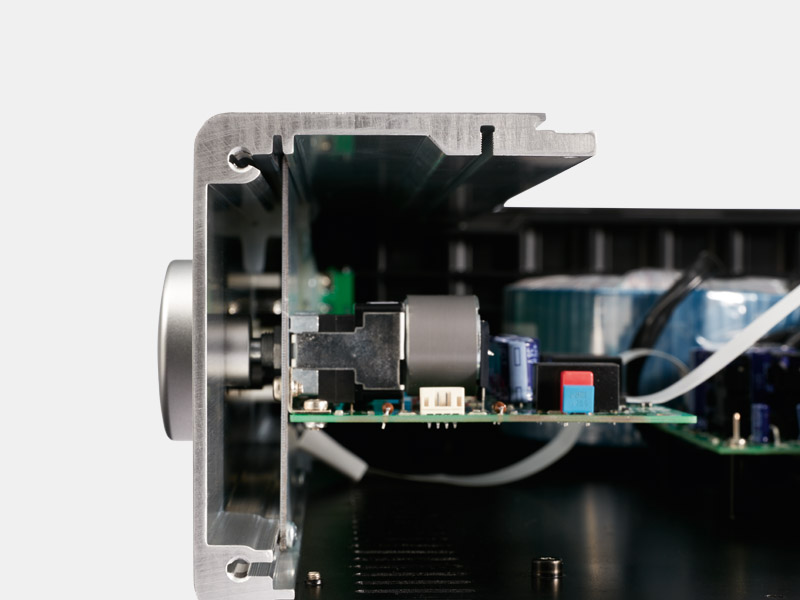
  • An amplifier's mains power supply is also a fair indication of the stability you can expect from the unit. Here the size (weight of the mains transformer) and the value of the supply reservoir capacity are decisive. Basically it is also true that a mains power supply whose reservoir capacity is distributed amongst many smaller capacitors responds more quickly than a conventional mains section, and is therefore able to supply higher currents even at high frequencies.


Overload and protection circuits

The vast majority of loudspeaker faults are a result of overload situations. There are two main causes of this problem:


1. Overloading the loudspeaker
Overloading the speaker is actually less of a problem, since a loudspeaker produces clearly audible distortion when it reaches the limit of its load capability. If this should hap-pen, please reduce the volume to protect your speakers from damage.

2. Overloading the amplifier (clipping)
The term clipping describes a situation in which the signal peak is cut off, or clipped, when the amplifier is overloaded.The distortion to the amplifier output signal which occurs as a result of clipping is very high in energy, but is usually of very high frequency.In some circumstances the distortion is inaudible, but is still capable of wreking a loudspeaker within a few seconds. As a basic rule, an amplifier with a higher output power will reach its clipping threshold later.You are therefore less likely to damage a loudspeaker by clip-ping if you use a powerful amplifier.There are many amplifiers which reduce the danger of clipping by special circuitry which produces what is sometimes termed "soft clipping".However, the best protection against this destructive problem is an amplifier fitted with a clipping protection circuit, which switches off the speaker output immediately if clipping should occur.Such an amplifier provides effective protection for the loudspeakers without affecting the quality of sound.All T+A amplifiers are fitted with a Protection circuit, which protects the speakers from clipping in this effective manner.